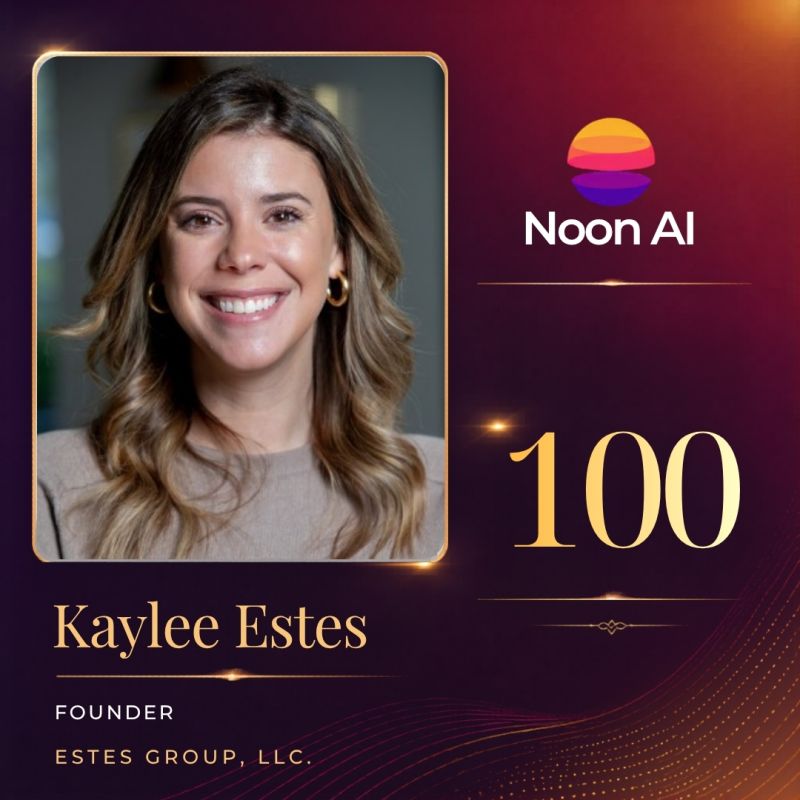
Estes Group’s Founder Named to Noon AI’s Top 100 Talent List
Kaylee Estes
Estes Group
“Focusing on quality will always win, and relationships. We’re in the relationship business.”
Kaylee Estes entered recruiting almost by accident. After graduating from Auburn University and beginning her career as an executive assistant, she joined a recruiting firm expecting to work in healthcare. Instead, she landed on the technical recruiting desk and found the foundation for a career that would eventually lead her to build Estes Group.
Today, Estes operates as more than a recruiter filling roles. As technical requirements evolve at extraordinary speed, she sees recruiters as market translators who can help hiring managers understand what talent actually exists and how companies need to adapt their expectations.
Building an Embedded Model
Estes Group has built its approach around getting closer to the businesses it serves. Rather than primarily operating through traditional contingent search, the firm embeds recruiters inside client organizations on a part-time basis.
Those recruiters function much like internal recruiters: owning hiring processes, working directly with hiring managers, and advising teams on what they should be looking for.
For Estes, that proximity matters because recruiting is becoming increasingly consultative. As roles and required skills change, recruiters need enough understanding of the business and talent market to challenge assumptions rather than simply execute a requisition.
When the Job Description Outruns the Market
Estes sees one of the biggest changes in recruiting happening inside the roles themselves.
Hiring managers increasingly request skills involving technologies that have existed for only a short time. A product manager might suddenly be expected to prototype with Claude or work fluently in Claude Code, even though the broader candidate market has had relatively little time to develop those capabilities.
That creates an important responsibility for recruiters. Staying current with the market allows them to tell hiring managers when expectations are realistic—and when a job description has moved faster than the available talent pool.
At the same time, recruiters face their own technology challenge. New sourcing platforms, meeting tools, applicant tracking systems, and AI products arrive constantly, creating what Estes describes as “tool overload.” The challenge is determining which tools genuinely improve the craft rather than chasing every new product.
Keep Your North Star
Amid all that change, Estes believes the fundamentals of recruiting remain remarkably stable.
Strong recruiters know how to design a good process, work effectively with candidates, and advise hiring managers. New technology can enhance those abilities, but it should not distract recruiters from them.
Relationships are especially important. Finding a candidate through a new sourcing technique is only the beginning; recruiters still need to build trust, maintain engagement, and guide that person through the hiring process. The same principle applies to relationships with clients and hiring teams.
Estes’ North Star is therefore deliberately simple: experiment with new technology without losing sight of quality and relationships. Tools will change, job requirements will evolve, and recruiting models will adapt—but being a trusted advisor to candidates and hiring managers remains the work that matters.
About the Talent 100
The Talent 100 is an annual recognition spotlighting leaders who are advancing HR and talent acquisition. Honorees are selected through peer nominations and independent selection committees, with selection based entirely on merit and no pay-to-play requirements. The initiative is organized by Noon AI.